
Style Analysis
Theory of Style answers your pressing questions on style, "dans tous les sens..."

Dr Marple asks:
Yesterday I was wearing the most nondescript/banal “classic” outfit of white tee and pale blue jeans and I felt horrifyingly visible. 🤷♀️ Yet today i am wearing another ‘classic’ of blue & white striped buttondown (about 6 sizes too big) and black trousers (limp) and I feel perfectly dressed and visible in the right way.
If a turn to the classics is more a methodology of flirting than a desire to co-opt their authority, what happens when we don’t enjoy the very specific visibility they confer on us? How do we test our disguises without becoming associated with their power regimes? Can we claim the classics without being claimed by them?
(Obviously, this applies to both dressing and art making)
The style analyst will see you now…

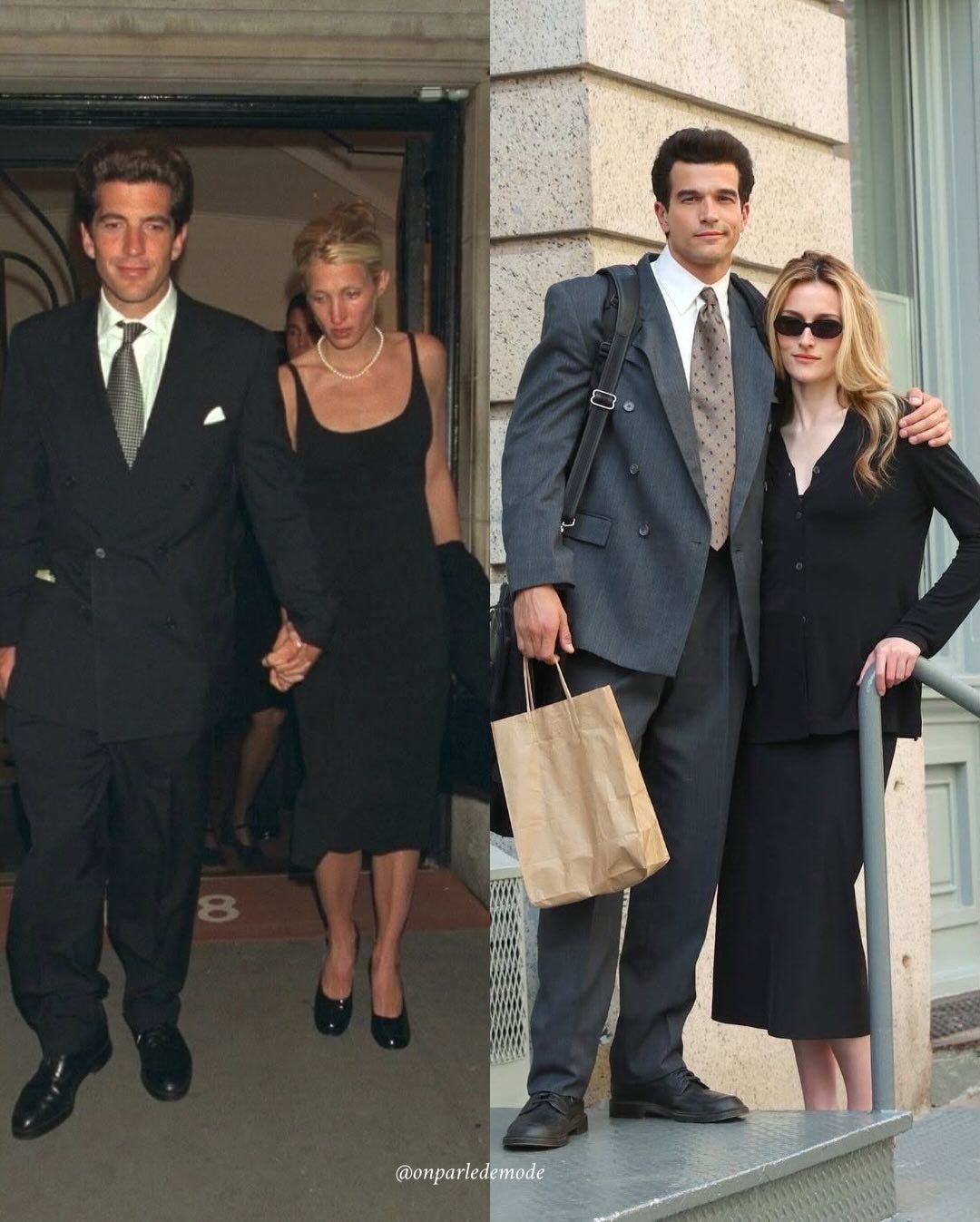
With the release of Christopher Nolan’s The Odyssey, we’re squarely in hot classics summer. Or maybe haute classics summer. I haven’t seen the movie and I have no intention to. But then I also have no intention to wear this summer’s haute fashion “classic,” the Carolyn Bassette-style slip dress (read my last post), as seen in Connor Hines’ FX series Love Story, which I haven’t seen either .
Emily Wilson, translator of The Odyssey’s 2017 edition, was “grateful” (in the London Review of Books) that Nolan made a classic visible to a wider readership, though she, as well as other critics, tell me the film renders “invisible” various aspects of Homer’s work: the poetry, the women, and a lot of material culture, including clothes. Wilson’s takeaway is that this is a drab, depressing adaptation: humourless, sexless, and the food, despite the frequent feasting in the poem “looks horrible”. Her assessment has, in turn, been blasted for being “elitist”.
If there’s art being produced here, it’s not only the works by Nolan, Wilson and Homer, but the discourse. UCC professor, James O’Sullivan dismisses this, asking, Why Don’t You Just Read the F-ing Odyssey? Spoiler: I haven’t read the (f-ing) Odyssey either. At the same time I haven’t not read it. I have read parts and I’ve encountered various interpretations, from Joyce to the Coen Brothers to Studio Ghibli. In other words, I’ve read around the text, the original remaining, at least partially, invisible.
But what has all this to do with the way “classic” garments make us “visible” in ways that feel “right” or “wrong”?
Like the Nolan movie, “classic” garments claim authority beyond themselves via provenance that remains invisible: they have an, often quasi-anonymous, mythic source. For a classic to work we have to know both that it’s a classic and that whatever contemporary interpretation differs from an original that is absent. Literary classics are, definitionally books no one has read. Once read they become a personal choice but, before reading, they threaten us from the library shelves.
The classic garment (and it’s always a garment rather than a full outfit, though an outfit can be made up of individual “classics”) has a glitching visibility held in tension with the wearer’s visibility.
A classic has the reputation of foregrounding the owner, but also of being visible enough to be “read” by authority. It is a password that allows the wearer to pass. Try one on and you know you are about to have an encounter with power.
Not all classics occupy the same place in power hierarchies. The trench may speak of warfare (and, as it was derived from a design for officers, class), but the workwear jacket, and the shell suit, (the DH Lawrence and Jean Genet of the clothes rail?) have recently entered the canon, followed by last season’s Miu Miu housecoat—a rare entirely femme clothing classic.
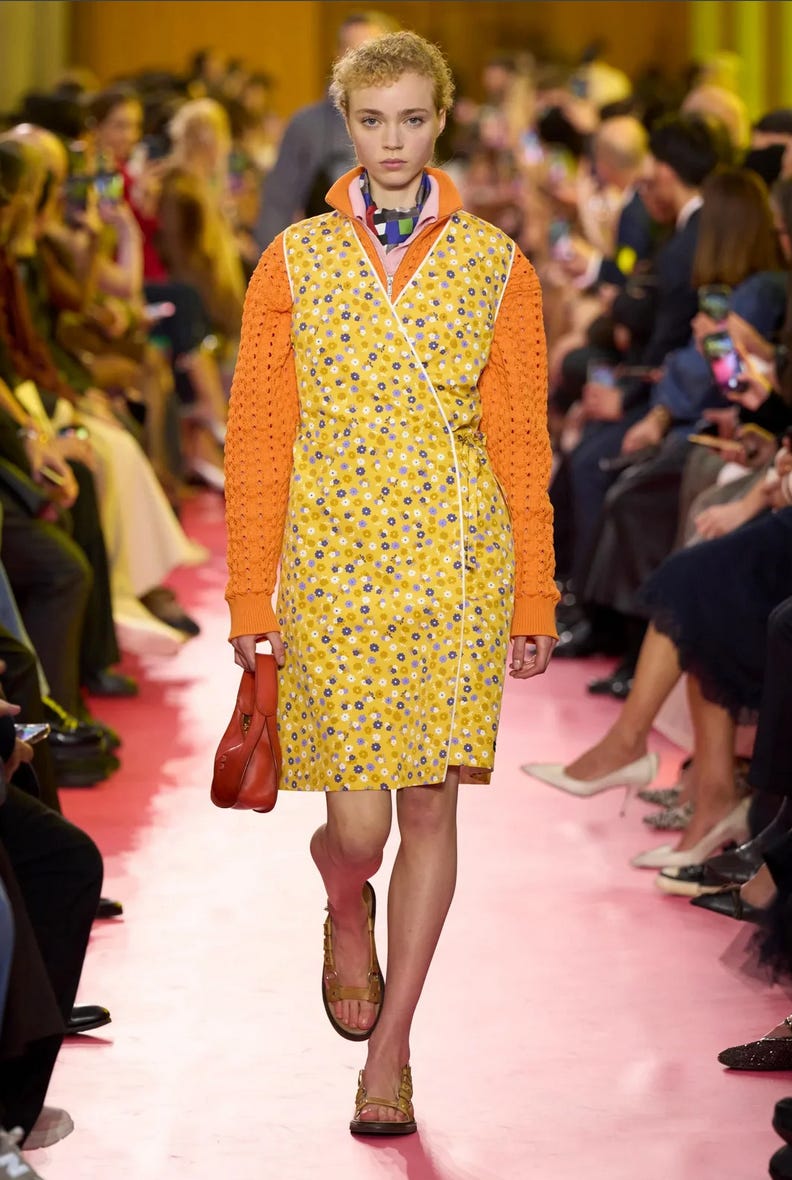
The housecoat is claimed as a classic at the moment increasingly few people wear it for its original function. It is the garment of unpaid domestic workers of an increasingly scarce older generation. (Likewise, a book is mostly only “classic” once the author is dead.) Contemporary, commercially-employed cooks and cleaners are more likely—as in the Nolan movie—to wear grim-coloured tabards.
To call a garment a classic is already to mark its displacement. We know the housecoat is a “classic” because it is becoming subject to interpretations. But there’s a painful double appropriation when working class-ics are reproduced as designer items. Though Miuccia’s intentions seemed to render women’s maintenance work visible and, though imitation is essential to fashion, and all fashion, even (or perhaps particularly) minimalism leans into parody, a €2550 housecoat isn’t, for example, a zoot suit. The appropriation and exaggeration of white-oriented business clothes by c20 black and Chicano hipsters was a classic declassified. To reverse this process, bringing a “non-classic” into the “classic” imaginary is very different. “Classic” garments’ claim to be “timeless,” just like costume designer Ellen Mirojnick’s aspirations for Nolan’s movie, is a disturbing attempt to strip them of political context.
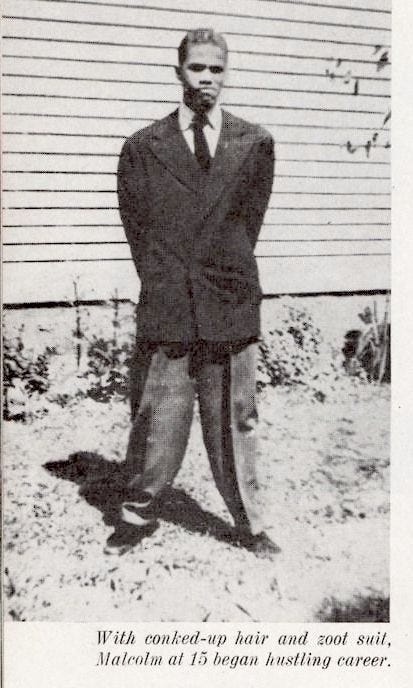

Classics mostly derive from menswear so, when women wear them, there’s already an element of appropriation that can distort the “visibility” and “invisibility” of the outfit and the wearer (see the double visibility/invisibility of female zoot-suiters).
A garment that exists, for a woman, in a field of “non-classics” can be, for a man, merely a jacket, a shirt. Of course not all men (and not all women) but the obsession with a traceable “original” garment found in excellent guy-oriented publications like Permanent Style and L’Etiquette (which has just brought out a supplement on 100 Icons of French Style) is very different to the “classics with a twist” line so often pushed in female-oriented fashion publications (apologies for the use of traditional genders alone here, but that’s how so many fashion publications still orient themselves).
This kind of reminds me of Foucault’s knicker-twisting over the difference between searching for origin and formatting a genealogy, in Nietzsche, Genealogy, History. And how, for Cixous, Butler, Braidotti, the matter of origin isn’t even a starter question.
But how to twist as methodology? There are a million influencer videos to tell you. It’s usually to do with some kind of mysterious golden mean proportion thing, or adding a scarf; all attempts to codify a je ne sais quoi, which is itself “invisible”.
Your second try of classics worked precisely because they were visibly “twisted”. Too ‘big’, too ‘limp,’ they were “classics-too” or maybe Classics.2. There are limits to queering when playing with authoritative forms (though, as Butler wrote, what the hell else do we have to play with?). With The Odyssey movie/book, this is inverted—in our current era of war on the arts and humanities, power lies with the Academy Awards, not the academy—but the power of classic clothes continues to be distributed between the blockbusting commercial clout of the latest interpretations, and the solid authoritarian power of the ‘real thing’.
So, to paraphrase O’Sullivan, why not just wear the f-ing classics?
It’s not as easy as it looks. Anyone who thinks they can clothe their bodies or their minds with “timeless classics” is onto a loser. It’s impossible to reproduce the original cultural context and any attempt will look like cosplay. Plus, one generation’s twist on classics doesn’t work the same way for the next. When classics read “right,” it is only with the acknowledgement of contemporary context.
A classic can’t be ‘decoded’ in any way that doesn’t give airspace to its history of meanings. It can only be détourned via the work of multitudes of wearers across space and time. As fashion is a social art, this offers hope. But so does attention to the sensual—to what’s “big,” or “limp”.

When you’re choosing “classics,” think less about the associations than the body’s relationship with them. Choose hairy tweed jackets, heavy satin shirts; thick, slippy nylon tracksuits. To paraphrase Sontag, why not an erotics of classics? To eroticise (a move against interpretation, as any Sontag-reader knows) casts flirting as an apt—perhaps the only possible—move.
Wilson notes that, sadly, Nolan’s Odysseus is neither a storyteller nor a flirt: his relationship to his origin text seems—to use another “classics” word— agon-ised. Agon is pain encountered in socio-legitimised struggle: war or sports. An encounter with “classic” clothing can feel like both. But, if fashion is an agon, the only goals scored and battles won are achieved not through struggle but through play. It’s participating in this play that matters.
All text (c) Joanna Walsh, 2026
Written in the Bibliothèque de la Poésie Contemporaine at the Centre Internationale de la Poésie, Marseille, France.
Do you need style analysis? If so, hit the button above.
The first 10 readers to take take out a year’s paid subscription will receive a free style consultation.
I’ll email you as soon as you’ve subscribed so you can send me a style problem, or you can gift this to someone else.
There’s no time limit so no need to send your question right away.
Your problem will be answered on Theory of Style or, if you prefer, privately.